How Much Water to Store Per Person (and How to Store It)
How much water to store per person: at least 1 gallon a day for 3 days, 2 weeks if you can. Chart for 1-6 people, container options and cleaning steps.
BLUF Bottom line up front
Store at least 1 gallon of water per person per day for 3 days. CDC says a 2-week supply is better if you have room. That gallon covers drinking and basic sanitation. Add more for pets, pregnant or sick people, and hot weather.
- Minimum: 1 gallon per person per day for 3 days. Target: 14 days if you can.
- A family of 4 needs 12 gallons for 3 days and 56 gallons for 2 weeks.
- Self-filled containers get replaced every 6 months. Sealed commercial bottles follow their expiration date.
- Water weighs about 8.3 lb per gallon, so plan where the weight goes.
- Never store water in containers that once held bleach, pesticides or other chemicals.
The short answer to how much water to store per person: at least 1 gallon (3.8 L) per person per day, for at least 3 days. CDC adds that a 2-week supply is better if you can manage it. Ready.gov uses the same one-gallon figure and calls it enough for drinking and sanitation.
Most people get that wrong in one of two ways. They store one case of bottled water and call it done, or they decide a gallon a day is silly and store nothing. Neither survives a burst main or a multi-day boil order.
This page gives you the numbers, a chart you can read in ten seconds, and the practical part: which containers to buy, how to clean them, and where they should sit.
The number: how much water to store per person per day
One gallon per person per day. That is the floor, not a comfortable amount.
Where does the gallon go? Ready.gov says a normally active person needs about three-quarters of a gallon of fluid a day, and that includes the fluid in other drinks. The rest of the gallon is for brushing teeth, rinsing hands, and cleaning a cut. It is not enough for showers, laundry or washing dishes properly.
Some people need more. Per CDC, store extra for pregnant women, sick people, pets and hot climates. Ready.gov adds that children and nursing mothers may need more, and that in very hot weather water needs can double.
Neither agency gives a per-pet number. A common rule of thumb is to count a dog or cat as a small extra person-share and size up from there. That is a guess, not guidance, so ask your vet if you have a large dog or several animals.
Note: Do not ration water unless officials tell you to. Ready.gov’s advice is to drink what you need today and look for more tomorrow. Cutting back on drinking to stretch the supply is how people end up dehydrated and still out of water.
How much water to store for a family of 4 (and everyone else)
Multiply people by days by 1 gallon. Here it is done for you.
| People | 3 days | 7 days | 14 days |
|---|---|---|---|
| 1 | 3 gal | 7 gal | 14 gal |
| 2 | 6 gal | 14 gal | 28 gal |
| 3 | 9 gal | 21 gal | 42 gal |
| 4 | 12 gal | 28 gal | 56 gal |
| 5 | 15 gal | 35 gal | 70 gal |
| 6 | 18 gal | 42 gal | 84 gal |
So the answer for a family of 4 is 12 gallons as a bare minimum, and 56 gallons for the 2-week target. Add pets and any hot-weather margin on top.
If you would rather not do the arithmetic, the emergency supply calculator does water and food for any household size and number of days.
3 days or 2 weeks?
Both numbers are official, and they answer different questions. Three days is the minimum for a short disruption: a storm, a main break, a one-day boil order. Two weeks is CDC’s goal “if possible”, and it matters more if you live somewhere that floods, freezes or loses power for long stretches.
Our take: start with 3 days this week. It costs very little. Then add a few gallons each time you shop until you hit 2 weeks. If you are on a private well with an electric pump, your tap stops working the moment the power does, so aim for the higher number sooner.
For where this fits in a bigger plan, see prepping for beginners.
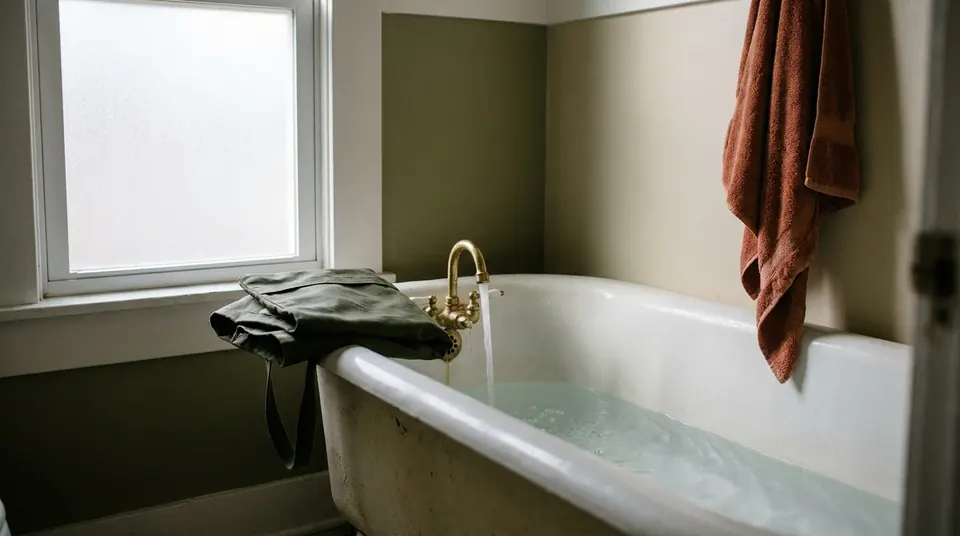
Emergency water storage containers
Any container works if it is food-grade, clean, and has a tight lid. Per CDC, use FDA-approved food-grade water storage containers. If you cannot, pick one that is durable, unbreakable (so not glass), has a tight-fitting top, and ideally a narrow neck.
Never use a container that previously held bleach, pesticides or other toxic chemicals. Milk jugs are a bad idea for a different reason: they are hard to clean fully, and they degrade. That one is a rule of thumb, not an agency rule, but it is a common recommendation.
| Container | Size | Pros | Cons |
|---|---|---|---|
| Commercial bottled water (cases) | 16-20 oz bottles, 1-5 gal jugs | Sealed, ready to drink, has an expiration date | Costs more per gallon, plastic waste |
| Food-grade jugs with spigot | 5-7 gal | Easy to pour, stackable | A full 5-gallon jug weighs about 42 lb |
| Food-grade barrel | 55 gal | Cheapest per gallon, one fill covers a family for weeks | About 460 lb full, needs a pump or siphon, stays put once filled |
| Bathtub bladder liner | Sold by tub size | Fast and cheap, uses the tub you already have | Fill it only when a storm or outage is coming, use up quickly |
| Water heater tank | Check the label on yours | Already there | Not storage you control, see below |
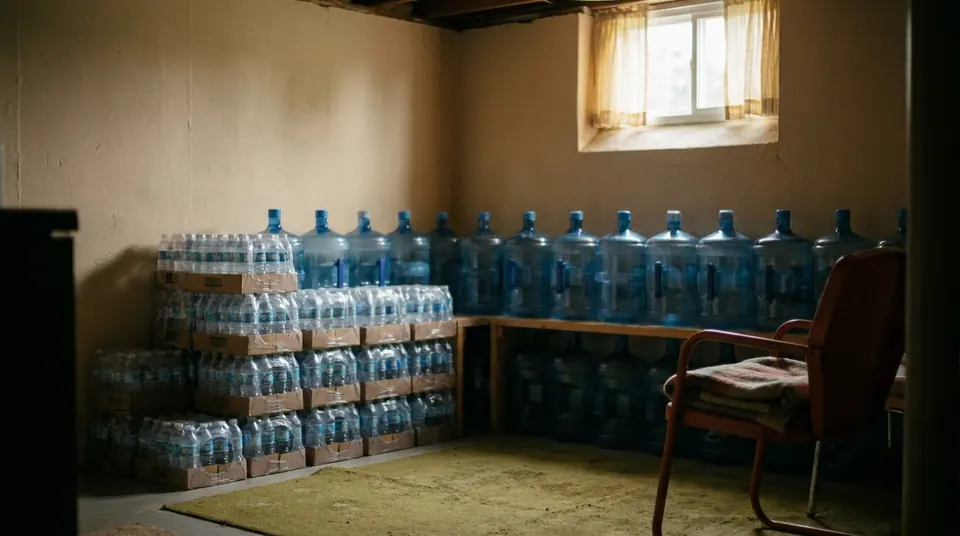
Weights are simple arithmetic: water is about 8.3 lb per gallon (3.8 L weighs about 3.8 kg). A 55-gallon barrel works out to roughly 460 lb, which is why it goes in a garage or basement corner on a floor that can take it, not an upstairs closet.
Mixing it up
Do not rely on one type. A sensible set for a 4-person household:
- A few cases of sealed bottled water for grab-and-go.
- Two or three 5-gallon jugs for the house.
- One bathtub liner stored with the kit, for known incoming storms.
That keeps you flexible if you have to leave in a hurry and cannot carry a barrel.
How to clean and fill your own containers
If you fill containers yourself, sanitize them first. This is CDC’s method, copied step by step.
- Wash the container with soap and rinse completely.
- Mix 1 teaspoon of unscented liquid household chlorine bleach (5%-9% sodium hypochlorite) into 1 quart (4 cups) of water.
- Cover the container tightly and shake so the solution touches all inside surfaces.
- Wait at least 30 seconds, then pour the solution out.
- Let the container air-dry.
- Fill with clean water and cover with a tight lid.
Use plain, unscented bleach only. Scented, color-safe or splashless products have added ingredients you do not want in drinking water.
If your tap water comes from a public system, it is already treated. You do not need to add bleach to the fill water. The bleach rules for making doubtful water safe are a separate topic, covered in how to make water safe to drink.
Label it
Write “drinking water” and the date on each container. CDC recommends this, and it saves an argument later about whether a jug is from this spring or two summers ago.
Where to store emergency water, and for how long
Cool and dark. CDC says to keep containers in a cool place, 50°F to 70°F (10°C to 21°C), away from direct sunlight and away from toxic substances like gasoline or pesticides. A garage next to the paint thinner and lawn chemicals is a poor spot. A basement shelf or closet floor is fine.
Replace stored water every 6 months. That applies to water you filled yourself. Per Ready.gov, commercially bottled water should stay sealed in its original container, so follow the date on the label.
Put a reminder in your phone for spring and fall. The clock change weekends work for some people. Rotate by using the old water on houseplants or the garden, then refill.
When you pour from a jug, use a clean scoop or a spigot. CDC says not to touch the water or the inside of the container with your hands. Fingers are the quickest way to turn stored water into a science experiment.
Who needs more than a gallon
The gallon is an average. Real households are not average. Here is who to plan extra for, and what the sources actually say.
- Hot weather. Ready.gov says needs can double in very hot temperatures. If you live in the Southwest or the Gulf Coast, or a summer outage is your main risk, size up. A summer heat wave with no power is the case where water and cooling problems arrive together.
- Pregnant women, nursing mothers and sick people. CDC and Ready.gov both say to store more. Neither gives a number. If a member of your household has a medical condition, ask their doctor what they need per day and use that.
- Children. Ready.gov says children may need more. Kids also lose track of drinking when they are scared or busy, so offer water often.
- Pets. No agency gives a figure. As a rule of thumb, small pets need little and large dogs need a real share. Add a buffer and rotate it with the rest.
- Anyone cooking. Rice, pasta and dehydrated meals soak up water. If your food plan involves boiling things, count that water on top of drinking water. The 2-week food list shows where this matters.
Mistakes that make stored water useless
Most failures are boring.
- Storing it where you cannot reach it. Barrels behind a wall of boxes do not help. Put at least some water near the door you would use.
- Storing it somewhere hot. A garage in July gets well above CDC’s 50-70°F range. Hot plastic and sunlight are bad for water in jugs.
- Forgetting the date. No label, no way to know. Write it on the jug.
- Buying only bottles. Bottles are great, but a 24-pack is about 3 gallons. For a family of 4 for 2 weeks, that is nearly 19 cases. Mix in larger jugs.
- Having no way to treat more. A bottle of unscented bleach and a pot cost almost nothing. Know how to do it before the stored water runs out.
Extra water sources inside the house
Your stored water should be the first line, but your home holds more than you think. These are backup, not plan A, and some need treatment first. The full list, with what to avoid, is in what to drink when there is no water.
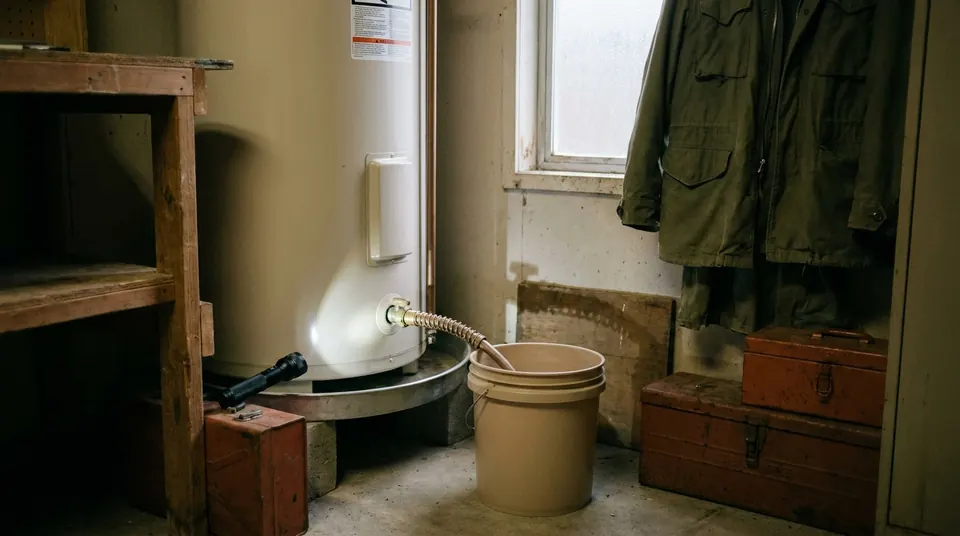
Quick version: the water heater tank, water left in your pipes, and ice in the freezer.
What about water for flushing and washing?
The 1-gallon figure leaves out toilets. A flush uses a few gallons, and it adds up fast. Two common workarounds:
- Keep a few gallons of non-drinking water (rain barrel, pool, or tub fill) for flushing and washing.
- Keep a box of heavy-duty garbage bags and a bucket as a backup toilet.
Neither of those is an official number. They are practical rules of thumb that many households use, and worth deciding on before you need them.
A weekend plan
- Do the math with the chart above or the calculator.
- Buy enough sealed water for 3 days for everyone in the house, pets included.
- Pick a cool, dark spot and write the date on everything.
- Set a 6-month reminder for any water you filled yourself.
- Read the next article, so you know how to treat water if your supply runs out.
Frequently asked questions
How much water do I need per person per day in an emergency?
At least 1 gallon (3.8 L) per person per day, for drinking and basic sanitation. Ready.gov and CDC agree on that figure. Plan on more for children, nursing mothers, sick people, pets, or if the weather is hot. In very hot conditions, Ready.gov says water needs can double.
How many gallons of water should I store for a family of 4?
For 3 days, 12 gallons. For a week, 28 gallons. For the 2-week target CDC recommends where possible, 56 gallons. Add extra for pets and hot weather. If your supply is on a well with an electric pump, lean toward the higher number.
How long can you store emergency water?
Sealed commercial bottled water is good until the expiration date on the label. Water you fill yourself should be replaced every 6 months, per CDC and Ready.gov. Store it between 50°F and 70°F, out of sunlight, and away from fuels and chemicals.
Is 1 gallon per person per day enough?
It is the official minimum, and it is built for short emergencies. It leaves little room for washing, and it gets tight in heat, with kids, or when someone is sick. Aim for more once you have the basics covered.
Can I store tap water in plastic containers?
Yes, if the container is food-grade, clean, sanitized, and has a tight lid. CDC says to use FDA-approved food-grade containers, not ones that held chemicals, and not glass. Wash, sanitize with the bleach solution above, air-dry, fill, and label with the date.
Sources
This guide is general information, not professional, medical or legal advice. Follow instructions from local officials during an emergency. Full disclaimer.