How Long Does Food Last in the Fridge Without Power?
A closed fridge keeps food safe about 4 hours, a full freezer about 48. Here is the USDA keep-or-toss chart, plus how to stretch both without a generator.
BLUF Bottom line up front
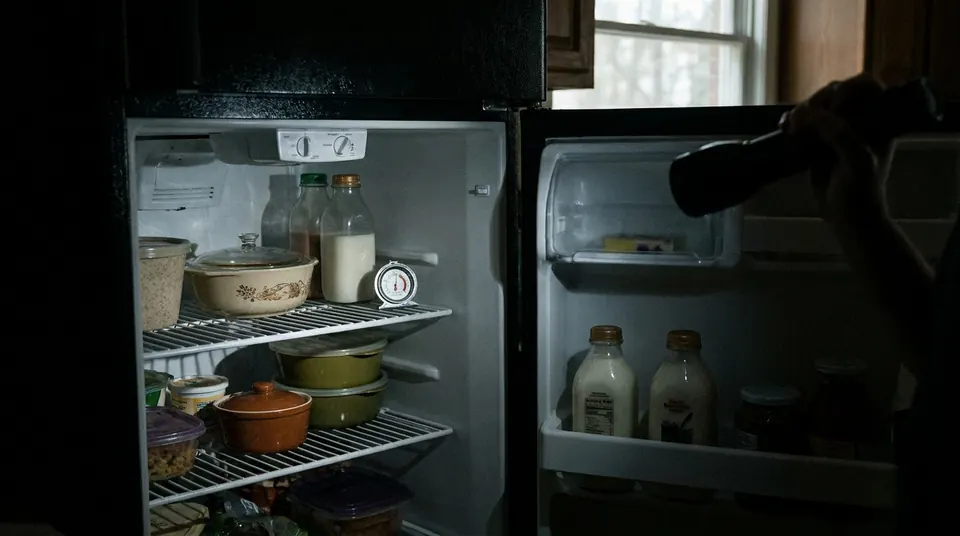
A closed refrigerator keeps food safe for up to 4 hours without power. A full freezer holds its temperature for about 48 hours, or 24 hours if it is half full, as long as nobody opens the door. After 4 hours, throw out meat, poultry, fish, eggs and leftovers.
- Fridge: about 4 hours with the door closed. Then discard meat, poultry, fish, eggs and leftovers.
- Freezer: about 48 hours if full, about 24 hours if half full. Door stays shut.
- Never taste food to decide. Use a thermometer: 40°F (4°C) or below in the fridge is safe.
- Hard cheese, butter, whole fruit and most condiments usually survive. Cut produce, dairy and cooked food usually do not.
- Fifty pounds of dry ice keeps a full 18 cubic foot freezer cold for about 2 days.
How long does food last in fridge without power? About 4 hours, if you keep the door shut. That is the official USDA figure, repeated on FoodSafety.gov.
A full freezer does much better: about 48 hours. Half full, it manages about 24.
Those numbers are the headline. The useful part is what happens at hour five, what to keep, what to bin, and what to do in the meantime so you lose less. Read the next section first if the lights just went out.
What to do in the first hour
- Stop opening the doors. Every look costs you cold air you cannot replace.
- Note the time. Write it on a sticky note on the fridge. People forget when an outage started, and the 4-hour clock depends on it.
- Check for a thermometer inside. If you have an appliance thermometer, read it through the door seal gap only when you must. More on that below.
- Move the stuff you would hate to lose. Milk, meat and leftovers go in a cooler with ice or into the freezer, if the freezer is still full of frozen food.
- Decide on ice. If the outage is forecast to run long, buy block ice or dry ice now, before the stores run out.
How long does food last in fridge without power: the numbers
The USDA gives three numbers worth memorizing. They come from USDA FSIS guidance and the FoodSafety.gov chart.
| Appliance | How long it holds safe temperature | Condition |
|---|---|---|
| Refrigerator | Up to 4 hours | Door kept closed |
| Full freezer | About 48 hours | Door kept closed |
| Half-full freezer | About 24 hours | Door kept closed |
Two things matter more than people expect.
First, “full” is doing real work. A packed freezer is a block of cold. Frozen food keeps the other frozen food cold. A freezer with half its shelves empty is mostly air, and air warms fast.
Second, these are the upper end for a closed, normally working appliance. A fridge in a hot July kitchen will lose its cold faster than one in a cool January pantry. Treat the numbers as the best case, not a guarantee.
The 4-hour rule versus the 2-hour rule
You will see both numbers on the official chart, and they confuse people.
- 4 hours is how long a closed fridge keeps food at a safe temperature.
- 2 hours is how long perishable food can sit at 40°F (4°C) or above before the chart says to discard it.
They work together. Your fridge buys you roughly 4 hours of cold. Once the inside climbs past 40°F, the 2-hour clock on the food starts. Without a thermometer you cannot tell when that happened, so the practical rule is to discard perishables after 4 hours without power.
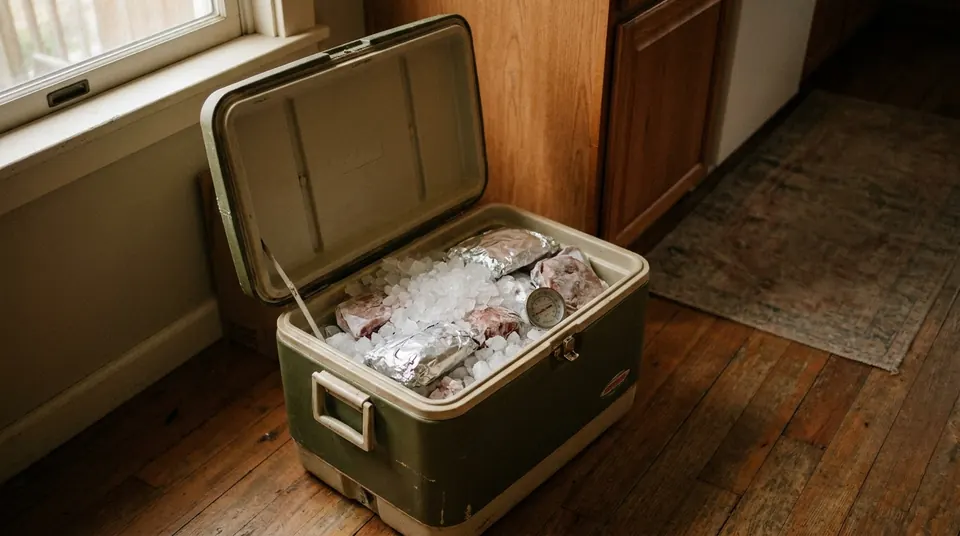
How long does meat last in the fridge without power?
Not long. Raw meat, poultry, fish and seafood go in the bin after 4 hours without power. So do cooked meat and leftovers. FoodSafety.gov lists raw or leftover cooked meat, poultry, fish and seafood, soy meat substitutes, gravy, stuffing and broth as “discard” once they have been at 40°F or above for more than 2 hours.
Meat in the freezer is a different story. If it still has ice crystals and feels cold like it came from a refrigerator, it can be refrozen. Quality may suffer. Safety does not.
What to throw out after a power outage: the keep-or-toss chart
This is condensed from the FoodSafety.gov refrigerated food chart. It applies to food that has been at 40°F (4°C) or above for more than 2 hours. The full chart is longer, so check it for anything not listed here.
| Food | Verdict | Notes |
|---|---|---|
| Raw or cooked meat, poultry, fish, seafood | Discard | Includes soy meat substitutes |
| Lunchmeat, hot dogs, bacon, sausage | Discard | |
| Casseroles, soups, stews, pizza | Discard | |
| Egg, tuna, chicken, potato salad | Discard | |
| Fresh eggs, hard-boiled eggs, egg dishes | Discard | |
| Milk, cream, yogurt, sour cream | Discard | Opened baby formula too |
| Soft cheeses (brie, mozzarella, cream, cottage, ricotta) | Discard | |
| Shredded cheese | Discard | |
| Hard cheeses (cheddar, Swiss, Parmesan, provolone) | Keep | |
| Processed cheese slices | Keep | |
| Butter, margarine | Keep | |
| Cut fresh fruit and vegetables | Discard | |
| Whole fresh fruit and vegetables | Keep | |
| Cooked vegetables, cooked pasta, rice, potatoes | Discard | |
| Pre-cut, pre-washed bagged greens | Discard | |
| Opened mayonnaise, tartar sauce | Discard | Chart wording: if above 50°F (10°C) for more than 8 hours |
| Opened creamy dressings, opened spaghetti sauce | Discard | |
| Ketchup, mustard, jelly, relish, pickles, olives | Keep | |
| Peanut butter | Keep | |
| Opened vinegar-based dressings | Keep | |
| Bread, rolls, muffins, tortillas | Keep | |
| Refrigerator biscuit dough, cookie dough | Discard | |
| Opened fruit juice, opened canned fruit | Keep | Opened vegetable juice: discard |
| Garlic in oil (commercial) | Discard |
A few patterns help you guess at things the chart skips. Moist, protein-rich, cooked or cut foods spoil fast. Dry, salty, acidic or very sugary foods tend to hold up. That is a rule of thumb for the unknown cases, not a replacement for the chart.
Tip: Never taste food to see if it is still good. The USDA says so directly. Many dangerous bacteria cause no change in smell, taste or look.
How long does food last in the freezer without power?
A full freezer holds about 48 hours. A half-full one holds about 24. The door has to stay closed the whole time.
When power returns, you have two checks:
- Does the food still contain ice crystals and feel cold, as if it came from a refrigerator? You can usually refreeze it.
- Has it been at 40°F or above for more than 2 hours? Most of it goes in the bin.
The FoodSafety.gov frozen chart is more forgiving than the refrigerator one. Meat, poultry and seafood that still have ice crystals can be refrozen. Hard cheese, bread and flour can be refrozen even after warming. Ice cream and frozen yogurt cannot: discard it once it has melted. Frozen vegetables are the odd ones. They can be refrozen with ice crystals, but the chart says to discard them after they have been held above 40°F for 6 hours.
Refrozen food can lose texture and flavor, so use it sooner rather than later.
How to make your food last longer
You cannot add hours to a fridge. You can stop wasting the ones you have.
Keep the doors shut
The biggest single lever, and the one people fail. Plan your trips. Decide what you want, then open once. A fridge that stays shut keeps its cold. One that gets opened ten times does not.
Group frozen food together
The USDA advises packing freezer items close together. They hold the cold better as a mass. If the freezer is half empty, fill the gaps with water bottles, jugs or bags of ice. This is cheap and it works.
Use a thermometer
Put an appliance thermometer in the fridge and the freezer now, not during the outage. The USDA targets are 40°F (4°C) or below in the fridge and 0°F (-18°C) or below in the freezer. A $5 to $15 thermometer (approximate price) turns a guess into a decision.
Add ice
Block ice or bags of ice in the fridge slow the warm-up. Coolers help too. Move milk, meat and leftovers into a cooler packed with ice, and keep the cooler out of the sun.
Dry ice
For an outage that will clearly run past a day, dry ice is the strongest option. The USDA says 50 pounds of dry ice should hold a full 18 cubic foot freezer for about 2 days. A half-full freezer needs less. Read the supplier’s handling instructions. USDA guidance says to avoid touching dry ice with bare hands and to keep it from direct contact with food. Use gloves.
Cook what will not keep
If you have a camp stove or gas grill (outdoors only), cook the meat and eggs from the fridge in the first hours. You are not extending the shelf life of the raw food by much, but you are eating it instead of binning it. Cooked food still needs to be eaten promptly or kept cold.
Safety: Never use a grill, camp stove or generator indoors or in a garage. Carbon monoxide kills, and the CDC says to run gas-powered equipment outside, at least 20 feet from doors, windows and vents. See our guide to how to stay warm without power for the full rules.
What if the power is out for days?
Eat down the fridge first, then the freezer, then the pantry. Fresh food goes in the first 4 hours. Frozen food goes in the next two days. After that you live on shelf-stable stock.
That is the whole argument for a pantry. A small stack of canned and dry food turns a three-day outage into an inconvenience. Start with the best canned foods for emergency storage and keep your power outage checklist printed where you can find it.
If outages are common where you live, think about powering the fridge itself. A generator or battery system can do it, with limits. Our guide to off-grid power options shows what a fridge actually needs.
What to do after the power comes back
- Check the freezer first. Look for ice crystals and cold, refrigerator-like temperature.
- Read the thermometers. Fridge at 40°F or below means the food probably stayed safe.
- Go through the chart above, item by item.
- Bin anything that looks wrong, smells wrong or has an unknown history. When in doubt, throw it out.
- Clean up spills. Thawed meat juice on a shelf is a cross-contamination problem.
Frozen food that is still solid in the middle is fine. Food that thawed and sat is not. Do not refreeze anything that fails the chart.
What to do this weekend
- Buy two appliance thermometers and put one in the fridge, one in the freezer.
- Freeze a few water bottles or jugs. A full freezer is a better freezer.
- Pick one cooler that fits your fridge essentials, and know where it is.
- Write the 4-hour and 48-hour numbers on a card and tape it inside a cupboard door.
Frequently asked questions
How long can a fridge stay closed during a power outage?
About 4 hours, according to the USDA. That assumes the door stays closed and the room is not hot. After 4 hours, discard meat, poultry, fish, eggs and leftovers. Use a thermometer if you have one: food at 40°F (4°C) or below is still in the safe zone.
How long will a freezer stay cold without power?
A full freezer holds a safe temperature for about 48 hours. A half-full one holds about 24 hours. Both numbers assume you do not open the door. Packing the freezer tight, and filling gaps with water bottles, helps.
Can I refreeze food after a power outage?
Yes, if it still contains ice crystals or feels as cold as refrigerated food, per the USDA. Quality may suffer. Do not refreeze food that has been above 40°F (4°C) for more than 2 hours, with some exceptions on the official chart such as hard cheese and bread.
Is milk safe after 4 hours without power?
No. The USDA chart says to discard milk, cream, yogurt and sour cream once they have been above 40°F (4°C) for more than 2 hours. Without a thermometer, treat milk as unsafe after 4 hours without power. Butter and margarine are the exceptions.
How much dry ice do I need for a freezer?
The USDA says 50 pounds of dry ice should keep a full 18 cubic foot freezer cold for 2 days. Use gloves, do not touch it with bare hands, and keep it off food directly. For a smaller freezer, scale down. For a half-full freezer, you need less.
Can I tell if food is spoiled by smell?
No. The USDA tells people never to taste food to determine its safety after an outage. Dangerous bacteria often cause no change in smell, taste or appearance. Use time, temperature and the keep-or-toss chart instead.
Sources
This guide is general information, not professional, medical or legal advice. Follow instructions from local officials during an emergency. Full disclaimer.